When you picture travelling between European cities, it is easy to automatically think trains.
And yes, trains are usually faster, comfortable and wonderfully convenient. But while planning my recent Europe trip, I discovered another option that made a lot of sense for a budget-conscious traveller: FlixBus. You can also look into other Bus travel providers who provide similar services. FlixBus was the most popular one, so I went with it and here’s my experience.
I used FlixBus to travel from Amsterdam → Brussels → Bruges → Paris, and the experience was surprisingly easy. In fact, for this particular itinerary, I found that the extra travel time on a bus was a small price to pay for the savings.
I deliberately chose to travel in the less conventional direction. The popular itinerary is often Paris → Belgium → Amsterdam. I wanted to do the opposite: start with Amsterdam, move through Brussels and Bruges, and save Paris for the end. There was something appealing about gradually moving from the quieter, prettier cities to the big, exciting finale.
And FlixBus made that progression very affordable.
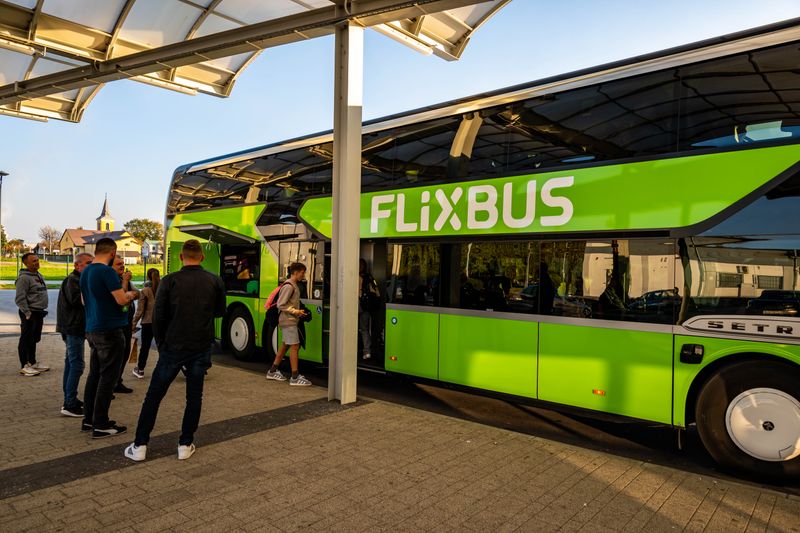
Image – Vladimir Srajber/ All other images in this post are my own
My Amsterdam → Brussels → Bruges → Paris bus itinerary
I didn’t simply pick the cheapest buses. There were several departures on these routes, and I chose timings that worked with my hotel/hostel check-out and check-in times.
That turned out to be one of the biggest advantages of travelling by bus.
Amsterdam → Brussels
17 June 2026
- Departure: 10:00 am — Amsterdam Sloterdijk
- Arrival: 1:00 pm — Brussels-North
- Journey time: 3 hours
- FlixBus: Route 810
- My fare: €17.67
- Seat: 4D (I paid extra for the seat for a better view)
My boarding pass shows Amsterdam Sloterdijk as the departure point and Brussels-North as the destination.
FlixBus currently lists multiple daily connections on the Amsterdam–Brussels route, with the journey taking around 2 hours 40 minutes on some services; actual journey times vary by departure and traffic.
For me, the three-hour scheduled journey was perfectly acceptable.
I wasn’t in a rush. I had checked out of my accommodation in Amsterdam and was heading towards Brussels anyway. Rather than spending substantially more for a faster train, I could sit comfortably, charge my phone, watch the scenery and arrive in another country.
Brussels → Bruges
18 June 2026
- Departure: 11:35 am — Brussels-North
- Arrival: 1:25 pm — Bruges (Station Brugge)
- Journey time: 1 hour 50 minutes
- FlixBus: Route B840
- My fare: €7.98
- Seat: 12A
This was an absolute bargain.
And once again, the timing worked beautifully with my accommodation plans. I didn’t have to wake up ridiculously early or spend half a day waiting around after checking out.
FlixBus lists Brussels–Bruges journeys at around 1 hour 20 minutes on some services, although my particular scheduled journey was 1 hour 50 minutes.
Bruges → Paris
20 June 2026
- Departure: 10:10 am — Bruges (Station Brugge)
- Arrival: 2:35 pm — Paris (Bercy Seine)
- Journey time: 4 hours 25 minutes
- FlixBus: Route 757
- My fare: €47.47
- Seat: 1A (I paid extra for the seat for a better view)
This was the longest of my three journeys, but again, I didn’t mind.
Four-and-a-half hours sounds like a lot when you’re looking at a timetable. Sitting on a comfortable coach and watching Europe go by is a very different experience from thinking about four-and-a-half hours of travel.
And importantly, it was still considerably less complicated than flying. No airport transfer, security queue, check-in process or waiting around at an airport.
My total cost
The three tickets cost me:
Amsterdam → Brussels: €17.67
Brussels → Bruges: €7.98
Bruges → Paris: €47.47
Total: €73.12
That covered three international journeys and two countries’ worth of city-hopping before arriving in Paris.
A note on prices and timings: The fares, departure times and journey durations mentioned in this post are from my own trip in June 2026. FlixBus operates multiple services on these routes, and prices and schedules change depending on the date and availability, so use these figures as a real-life reference rather than current fares.
But aren’t trains much faster?
Yes.
They are.
And if your priority is getting from one city centre to another as quickly as possible, I’d absolutely compare the train first.
But when I’m travelling for leisure, I don’t always think an extra hour or two is a problem.
In fact, I rather enjoy it.
There is something about travelling overland through Europe that you miss when you’re sitting inside a high-speed train – or flying above the landscape altogether.
You see the countryside change.
You see towns that you weren’t planning to visit.
You see highways, industrial areas, warehouses, roadside restaurants, petrol stations and little details that are completely different from country to country.
You start noticing the cars on the roads. The brands. The road signs. The architecture of roadside buildings. The names of petrol stations. The enormous warehouses and logistics centres that you would never encounter while sightseeing in a city.
It is the unfiltered, everyday Europe that tourists don’t necessarily set out to see.
And I actually find that fascinating.
I also love the vantage point you get from a bus. Sitting higher up gives you almost a bird’s-eye view of the landscape compared with sitting in a car, so you can see over hedges, barriers and traffic and take in much more of the countryside. I discovered how much I enjoyed this on my bus tour in the USA too — it made the journey itself feel like part of the sightseeing.
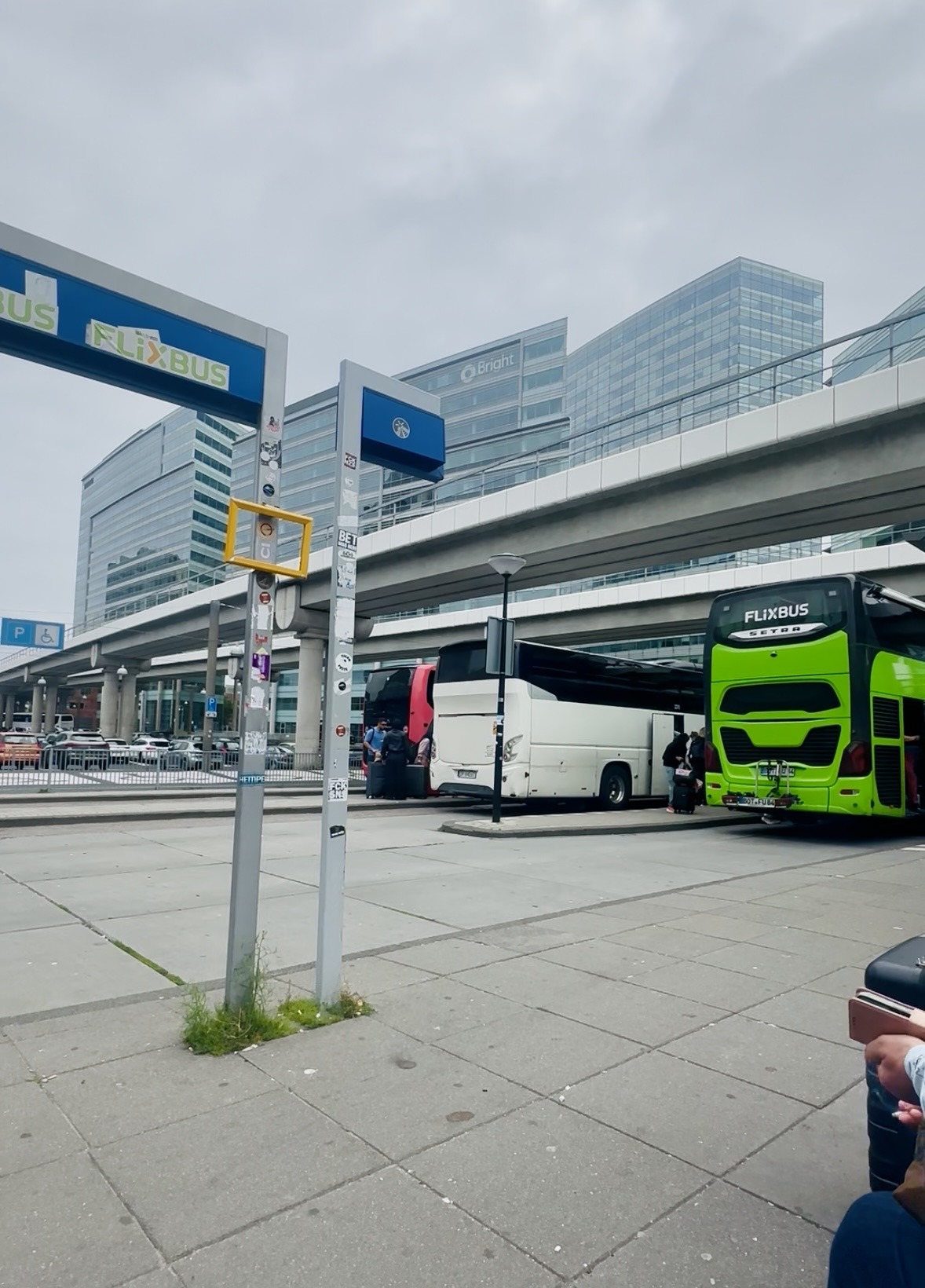
Flixbus Stop at Sloterdijk, Netherlands
The bus can solve the awkward check-out/check-in gap
This is perhaps my biggest tip if you’re considering FlixBus for a multi-city itinerary.
Think about what happens on a normal travel day.
Your hotel check-out might be at 11 am, but your next hotel’s check-in might not be until 3 pm or 4 pm.
What are you supposed to do with those hours?
You can leave your luggage at the hotel and wander around.
Or you can make those hours your travel time.
That’s exactly what I did.
Instead of seeing the time between check-out and check-in as dead time, I used it to move to my next destination.
This made the longer bus journeys feel much less inconvenient.
I wasn’t losing four hours of sightseeing. I was travelling during hours when I would otherwise have been in transit anyway.
What is a FlixBus actually like?
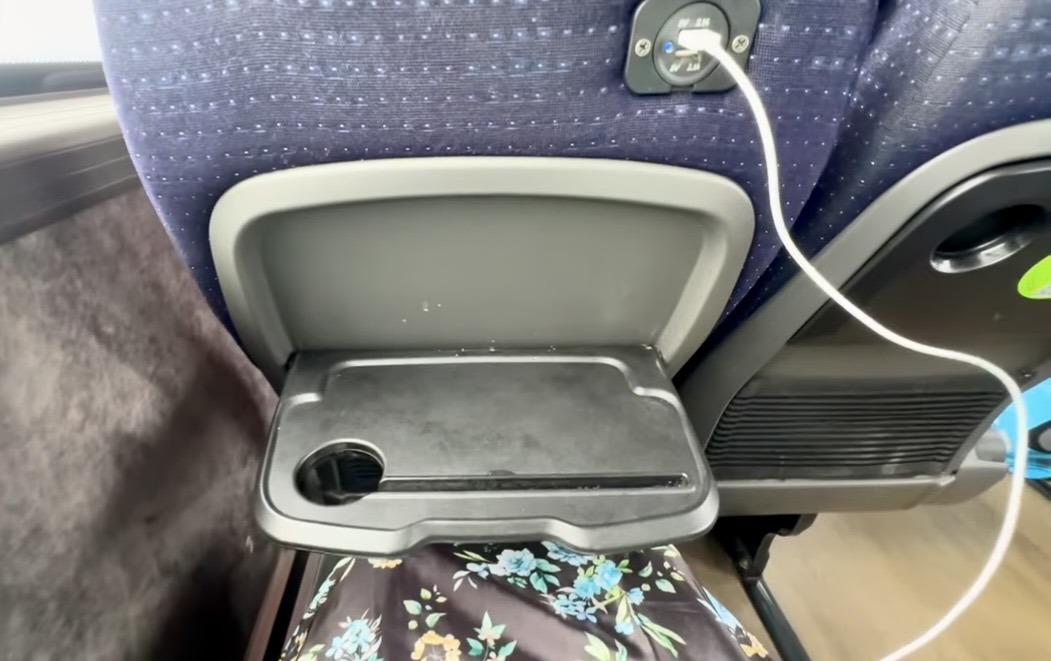
I was pleasantly surprised by the buses.
The seats have power outlets/charging points and tray tables, which makes a longer journey quite manageable. There is also a small hook where you can hang a plastic bag for your rubbish — a tiny detail, but one I appreciated.
FlixBus lists Wi-Fi, power outlets, comfortable seating, luggage storage and toilets among its onboard facilities, although equipment can vary by bus.
I personally never used the toilet, so I won’t pretend to review it. But toilets are listed as available on FlixBus services, subject to the specific bus/equipment.
Luggage was another plus
My tickets included:
- 1 small/hand bag up to 7 kg
- 1 larger checked/hold bag up to 20 kg
That allowance is also reflected on my boarding passes.
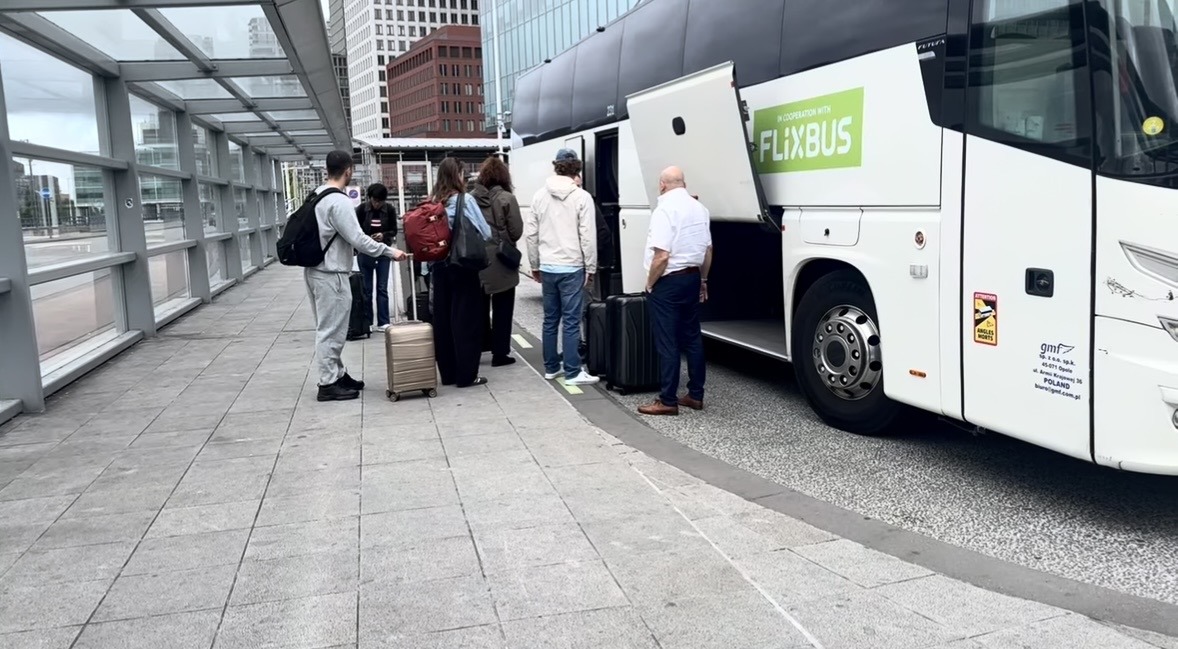
Flixbus has this storage area for your larger bags. You can keep your smaller bags with you in the overhead storage like flights.
For a European holiday with a suitcase, this is useful. You aren’t hauling your large luggage through a train carriage and trying to find somewhere to squeeze it in. You hand the larger bag over for the luggage compartment and take your smaller bag onto the bus.
Amsterdam: an easy start
My Amsterdam bus departed from Amsterdam Sloterdijk.
The boarding pass gave the exact location and even included a map and directions to the stop.
One thing I really liked about the FlixBus app was the amount of information available on the day of travel.
I could see the bus location, follow the journey and get updates. FlixBus itself recommends using its app to find the bus stop, track the bus in real time and receive updates about changes.
That made me much less nervous about navigating unfamiliar European bus stations.
Brussels: possibly the most convenient stop of the trip
This was probably my easiest arrival.
The FlixBus stop at Brussels-North was only about 2–3 minutes from my A&O hostel.
After arriving with luggage, that kind of convenience is priceless.
No complicated metro journey. No dragging a suitcase through several streets. No trying to figure out which side of a massive station you need to exit from.
Just get off the bus and walk to your accommodation.
For a budget traveller, I would strongly recommend looking at where the bus actually drops you, not just the ticket price. A €10 cheaper ticket isn’t necessarily cheaper if it leaves you with a €20 taxi ride or a miserable luggage haul at the other end.
Bruges: learn from my mistake!
This is where I made a completely avoidable mistake.
The FlixBus stop is at Bruges (Station Brugge), at the international bus stop in the Kiss & Ride area on the south side of Bruges train station. FlixBus confirms this location on its current station information.
I somehow didn’t understand this properly.
When I arrived in Bruges, I ended up dragging my luggage towards a bus stop that was much farther away — only to discover that I was heading towards a bus that was actually on its return route.
Yes. 🤦🏻♀️
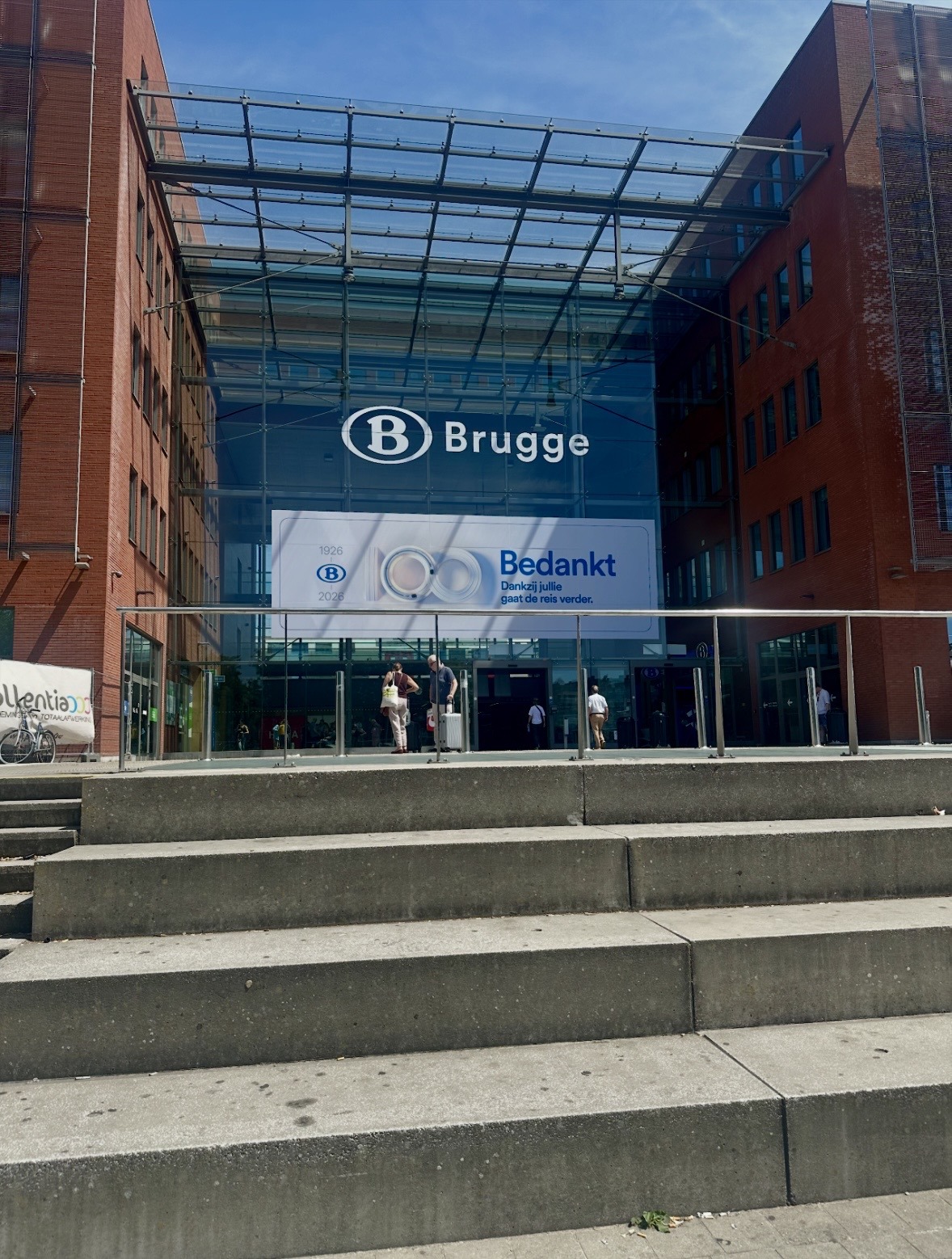
This is where your bus drops you. Just climb those steps, walk into the station, cross the length and walk out from the other side for the bus stop to take you to your hotel.
Fortunately, the bus driver was incredibly kind. He dropped me off at the front of the train station, which was actually where I needed to be.
And then I figured it out.
The trick is:
The FlixBus stop is behind the Bruges train station.
So if you’re travelling from Brussels into Bruges, don’t assume you need to walk around the station to find some mysterious distant bus stop.
Go inside the train station and walk through it.
The station is covered, so you aren’t wandering around outdoors with your luggage. Walk through the entire length of the station, exit on the other side and you’ll find the international bus stop at the Kiss & Ride area.
And the return journey was much easier
When I was leaving Bruges for Paris, I knew exactly where I needed to go.
My bus wasn’t until 10:10 am, so I could simply wait inside the train station.
I grabbed a coffee and a pain au chocolat from the Albert Heijn inside the station, sat down and waited until it was time to leave.
Then I walked through the station, exited at the back and went to the FlixBus stop.
Much better than my first Bruges experience!
My boarding pass itself identifies the departure point as Rijselstraat-Spoorwegstraat, and FlixBus currently specifies the international bus stop at the south side of the station.
And then… Paris
Arriving in Paris by bus is where you suddenly realise that you have entered big-city Europe.
My FlixBus dropped me at Paris Bercy Seine, 210 Quai de Bercy.
And this is where I would add a very important warning:
Be prepared to walk with your luggage.
Bercy Seine is a large coach terminal rather than a traditional city-centre railway station. Once you get off the bus, you have to make your way through the terminal/park area and towards public transport.
The closest major Metro station is Bercy, served by Metro Lines 6 and 14. RATP identifies Bercy as the closest metro station to the Bercy area, and current route information puts the bus terminal roughly an 8–10 minute walk from the station, depending on your exact exit/route.
So, if you are arriving in Paris with a large suitcase after four hours on a bus, don’t expect to step straight from the coach onto a metro platform.
You will be dragging that suitcase through the bus terminal/park area first.
And somehow, that felt like the perfect introduction to Paris.
The enormous city. The distances. The metro. The crowds. The suitcase.
The Paris experience begins practically the moment you get off the bus. 😂
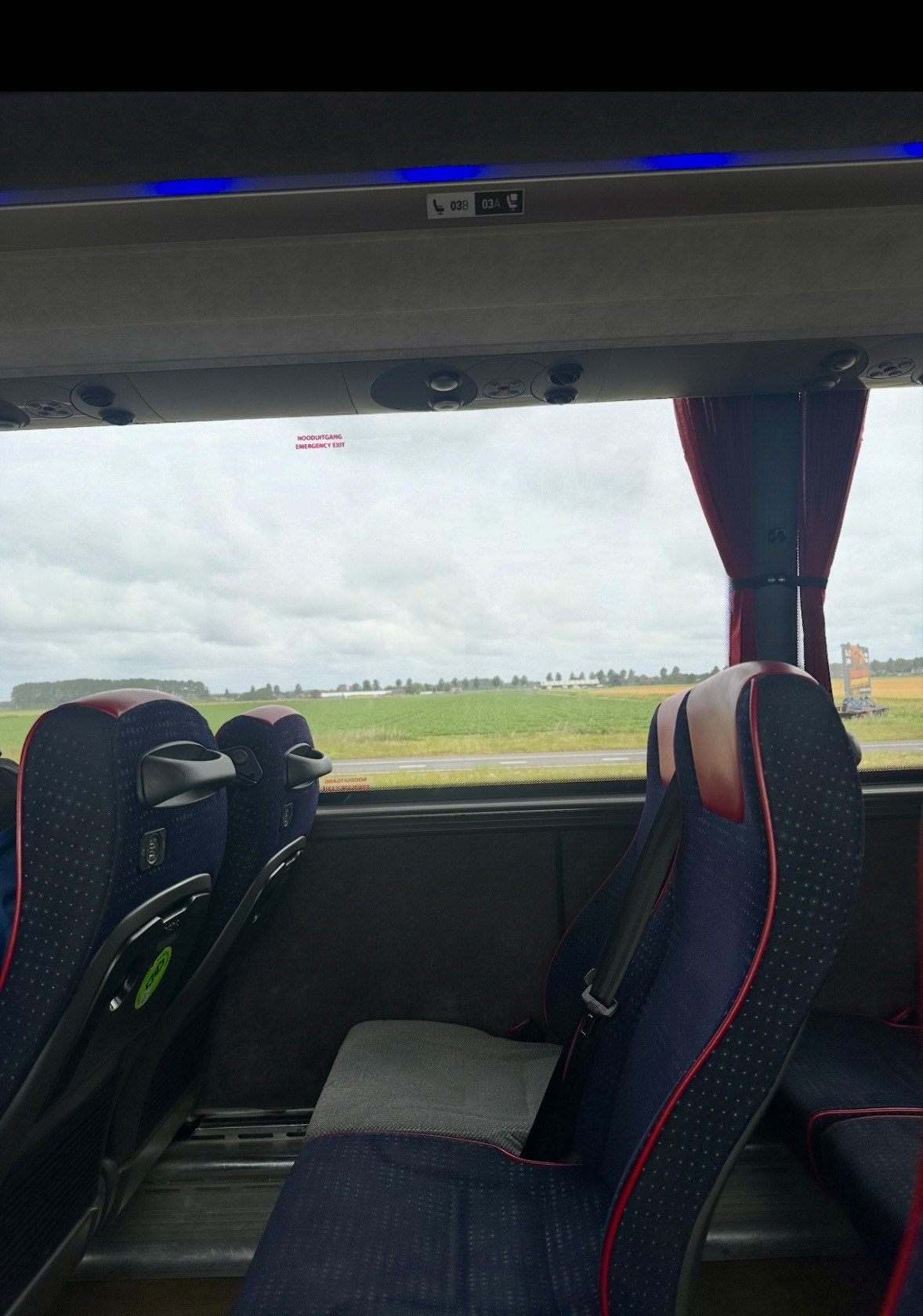
Enjoying the European countryside views!
One important lesson: book carefully
I actually used FlixBus for another journey during this trip — a day trip from Amsterdam to Den Haag — but I booked that particular ticket through Omio.
That experience was not nearly as smooth.
I didn’t receive the FlixBus updates I had become accustomed to, and I actually managed to miss my return bus.
This is not to say that Omio is a bad booking platform. It is a useful comparison and booking platform for trains, buses, flights and ferries, and it can provide live journey updates when they are available.
But my personal experience was that the FlixBus app gave me much better day-of-travel visibility for the FlixBus journeys I booked directly.
I could see the bus, follow its progress and get information about the exact stop.
So my preference now would be:
Compare prices and timings wherever you like, but if you’re booking FlixBus, I would seriously consider booking directly with FlixBus and using the FlixBus app for the actual journey.
That was simply the system that worked best for me.
(I’ll write separately about my Den Haag experience because there are a few lessons from that day too.)
So, would I choose FlixBus again?
Absolutely.
For this particular route, I wouldn’t hesitate.
I would choose a train if the price difference were small and the train saved me a significant amount of time. But if the bus is substantially cheaper and the timing works with my accommodation, I’d take the bus.
An extra one or two hours isn’t necessarily wasted time when you’re travelling.
You can read. Work. Watch something. Charge your phone. Look out of the window. Or simply watch Europe change outside your window.
And there is something very satisfying about waking up in one country, spending a few hours travelling through another, and getting off the bus somewhere completely different.
For my Amsterdam → Brussels → Bruges → Paris journey, FlixBus turned what could have been an expensive sequence of train journeys into a relatively inexpensive, straightforward road trip across three countries.
And I rather liked seeing Europe from the highway.
My tips for using FlixBus between European cities
1. Compare the bus AND train before booking.
Don’t automatically assume one is better. Look at price, journey time and — most importantly — where the stations are.
2. Check the actual departure and arrival points.
“Brussels” or “Paris” doesn’t tell you enough. The location of the bus stop can make a huge difference when you’re carrying luggage.
3. Match your bus to your accommodation timings.
This was the biggest win for me. Use your travel time to bridge the gap between hotel check-out and check-in.
4. Download the FlixBus app.
For my main three journeys, it was extremely useful for updates and tracking. FlixBus itself recommends the app for real-time tracking and stop information.
5. Arrive early.
My boarding passes advised arriving around 15 minutes before departure, and I would follow that advice — especially when you’re unfamiliar with the bus station.
6. Bruges: remember SOUTH SIDE / KISS & RIDE.
The international FlixBus stop is behind the train station, at the south-side Kiss & Ride area.
7. Paris: allow time for the luggage walk.
Bercy Seine is at 210 Quai de Bercy, with Bercy Metro (Lines 6 and 14) roughly a short walk away.
8. Don’t judge a bus journey only by its duration.
If you’re on holiday, the journey itself can be part of the experience.
The bottom line
Europe is often sold as a train-travel dream, and I completely understand why. But there is another way to country-hop that can make a big difference to your travel budget.
For my trip, I spent €73.12 on three FlixBus journeys: Amsterdam → Brussels → Bruges → Paris, with the longest scheduled journey taking 4 hours 25 minutes.
I saved money, avoided airports, travelled between cities during the otherwise awkward check-out/check-in hours, and got to see a completely different side of Europe along the way.
Sometimes the budget option isn’t the compromise. Sometimes it’s simply a different way of travelling.
And for my Amsterdam → Brussels → Bruges → Paris itinerary, I’d happily do it again.
[…] I didn’t know that because I received no notifications about it. It is only later on my other FlixBus travels throughout Europe, which I booked directly through the Flixbus App, that I realized that FlixBus sends you […]