If you have a teenager at home, there’s a good chance you’ve already heard about GTA 6.
Perhaps your son has been talking about it for months. Maybe your daughter has friends who are playing it. Or perhaps you’ve found yourself wondering why a video game seems to be generating so much excitement that everyone, including people who don’t normally play games, is talking about it.
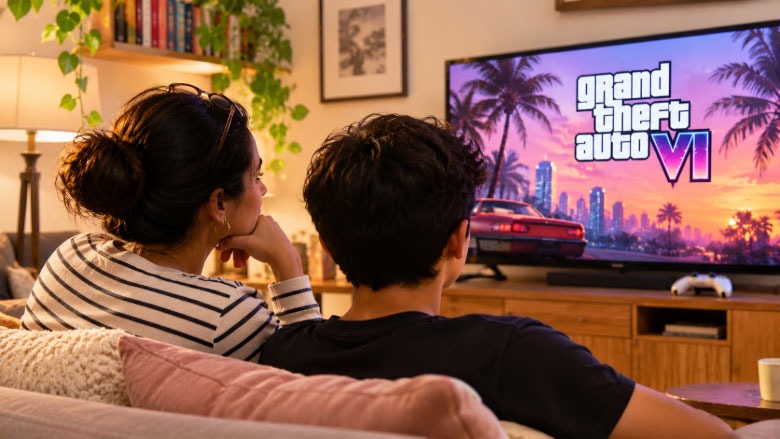
And then you’ve looked up what the game actually contains.
Violence. Guns. Robberies. Drugs. Sexual content. Strong language. And a rather long list of things that probably aren’t what you had in mind when you thought about buying your teenager a video game for Christmas.
So, should you allow your teenager to play GTA 6?
It’s a question many parents are asking, and I don’t think there’s a particularly easy answer.
As parents, we’re constantly trying to strike a balance between protecting our children and allowing them the freedom to enjoy the things their friends enjoy. We don’t want to be unnecessarily restrictive, but we also don’t want to turn a blind eye to content that might not be appropriate for their age.
And when it comes to video games, I think there’s a bigger conversation we need to have.
Is violence alone the deciding factor? Or should we be looking at the entire experience a game offers?
Let’s take a closer look.
First, what exactly makes GTA 6 an adult game?
Grand Theft Auto has never been a children’s game. If you’ve played an earlier instalment or even watched someone else play, you’ll know that the franchise has always revolved around crime, violence and adult themes.
GTA 6 continues that tradition.
The game follows Jason and Lucia, two characters involved in criminal activities in the fictional state of Leonida. Players can explore a large open world, undertake missions, participate in robberies, interact with other characters and make choices within the game.
But the content goes considerably beyond cartoon-style fighting or shooting at imaginary enemies.
According to the official Entertainment Software Rating Board (ESRB) rating, GTA 6 is classified as Mature 17+ in the United States.
Its content descriptors include:
- Blood and gore
- Intense violence
- Mature humour
- Nudity
- Strong language
- Strong sexual content
- Use of drugs and alcohol
The rating summary also describes gunfights, robberies, attacks on civilians, graphic injuries and dismemberment. There are sexual scenes, strip clubs, drug use and explicit language.
In other words, violence is only one part of the content parents need to consider.
And this is important because sometimes we hear about a game being violent and imagine that it simply involves shooting at other players. GTA 6 offers a much more extensive adult experience.
What is the actual age rating of GTA 6 in India?
This is worth clarifying because you might come across different ratings when reading international articles.
Video games are classified differently in different countries.
| Rating system | GTA 6 classification | What it means |
|---|---|---|
| India – PlayStation/Xbox storefronts | 18+ | Intended for adult players |
| ESRB – USA | Mature 17+ | Intended for ages 17 and above |
| PEGI – Europe | PEGI 18 | Adults only |
| Australia | R18+ | Restricted to adults |
The important thing is that all these classifications point in the same direction: GTA 6 is intended for adults, not children.
The Indian storefront classification is particularly relevant if you’re buying the game here. Don’t rely on an American rating you might have seen in a YouTube video or gaming review.
You can check the game’s listing on your console’s official store and read the accompanying content information.
I’d also suggest looking beyond the number. The content descriptors tell you much more about what your child might encounter.
But aren’t other popular video games violent too?
This is probably where the conversation gets interesting.
If you have children who play video games, you might already be familiar with Fortnite, Minecraft, Call of Duty and several other popular titles.
Some of these games involve shooting, fighting, weapons and battles. So why is GTA 6 being treated differently?
The answer lies partly in the way violence is presented, the realism of the graphics and the wider content of the game.
Let’s compare a few popular titles.
GTA 6 vs Fortnite
Fortnite is probably one of the most familiar games to parents of school-going children.
It involves players fighting each other in a battle royale format. They collect weapons, build structures and try to be the last player or team standing.
There is certainly violence involved.
However, Fortnite uses a much more stylised visual presentation. Defeated characters generally disappear in colourful effects rather than leaving behind realistic injuries and pools of blood.
The ESRB gives Fortnite a Teen rating, while its European PEGI rating is 12.
That’s a significant difference from GTA 6.
Fortnite also has online interactions and in-game purchases, which bring their own parental considerations. A lower age rating doesn’t mean parents should ignore those aspects.
GTA 6 vs Call of Duty
Call of Duty is another franchise that has attracted millions of players.
It features military combat, firearms, explosions, enemy soldiers and realistic shooting sequences.
Some instalments contain particularly graphic violence, blood and gore.
In fact, Call of Duty: Black Ops 7 carries an ESRB Mature 17+ rating, with descriptors including blood and gore, intense violence, strong language and drug references.
So, GTA 6 isn’t necessarily the only game in a teenager’s environment that contains graphic violence.
The difference is that Call of Duty generally centres on combat missions, whereas GTA gives players a much more open-ended environment.
In GTA, players can explore cities, interact with ordinary civilians, steal vehicles and commit crimes outside the main storyline. They can also choose to attack non-hostile characters.
That freedom is an important part of the experience.
GTA 6 vs Minecraft
Minecraft is probably the easiest comparison to understand.
It involves building, exploring, collecting resources and surviving in a virtual world.
There is violence too. Players fight zombies, skeletons and other creatures using swords, bows and other weapons.
However, the violence is stylised and largely fantasy-based.
Minecraft carries an ESRB Everyone 10+ rating for its Java Edition, with a Fantasy Violence descriptor.
It is obviously a very different experience from GTA 6.
A quick comparison
| Game | ESRB rating | Main content concerns |
|---|---|---|
| GTA 6 | Mature 17+ | Graphic violence, sex, nudity, drugs, strong language |
| Call of Duty: Black Ops 7 | Mature 17+ | Realistic combat, blood, gore, strong language |
| Fortnite Battle Royale | Teen | Stylised combat, violence, online interactions |
| Minecraft Java Edition | Everyone 10+ | Fantasy violence, online interactions |
Ratings can vary by platform, edition and country. These are US ESRB classifications for the specific versions mentioned.
What I find interesting here is that not all violence is presented in the same way.
A cartoon character disappearing after being hit is very different from a realistic depiction of a person being shot, injured or killed.
And then there’s the question of what else happens in the game.
Is violence in video games actually making children aggressive?
This is probably the biggest concern parents have.
Does playing a game in which you shoot people make a child more likely to behave aggressively in real life?
We’ve been debating this for years, and the research is more complicated than either side of the argument might suggest.
The American Psychological Association (APA) has addressed this issue in its research and public statements.
Its 2020 position acknowledged a small, reliable association between violent video game use and certain aggressive outcomes, such as yelling and pushing. However, it also cautioned that there isn’t sufficient scientific evidence to establish that violent video games cause violent behaviour.
That distinction matters.
An association between two things doesn’t automatically mean one causes the other.
Researchers also have to account for other factors, including a child’s existing behaviour, family environment, personality, social circumstances and exposure to violence elsewhere.
A 2020 meta-analysis examining 28 independent samples involving approximately 21,000 young people found that the relationship between aggressive gaming and later aggression was very small. The authors concluded that better-designed studies did not support a substantial long-term link.
A 2024 longitudinal study of Czech adolescents also examined the relationship between violent video games, aggression and empathy. It found associations between gaming and aggression when comparing different individuals, but did not find evidence that increased exposure within an individual led to the predicted desensitisation effect.
There are also studies suggesting that exposure to violent media can influence aggressive thoughts and attitudes under certain circumstances.
So, should we dismiss the concerns altogether?
I wouldn’t.
But I also wouldn’t tell parents that playing GTA 6 will automatically turn a perfectly well-adjusted teenager into an aggressive person.
That’s simply not what the evidence establishes.
The more sensible approach is to look at the individual child, the content they consume and how gaming fits into their overall lives.
Is the violence itself the biggest problem, or is it the entire content package?
This is where I think GTA 6 deserves a closer examination.
If the game contained only fictional fighting or shooting, we might have a slightly different discussion.
But GTA 6 combines several adult themes.
1. Violence and criminal behaviour
Players can participate in robberies, shootouts, car thefts and other criminal activities. The game also allows players to attack civilians and police officers.
The graphics are realistic, and some violent sequences are particularly graphic.
2. Sexual content and nudity
There are strip clubs, sexual scenes, nudity and sexually suggestive interactions.
This is something parents may not always consider when they think about video game violence, but it is an important part of the game’s mature content.
3. Drugs and alcohol
The game depicts drug use, drug trafficking and alcohol consumption.
4. Language and humour
Strong profanity, offensive language, sexual jokes and mature humour are part of the experience.
5. Freedom to experiment
Unlike a game where players follow a fixed sequence of combat missions, GTA offers an open world.
Players can decide how to interact with the environment and its characters. They can follow the storyline or spend time exploring the city and experimenting with different activities.
This freedom is one of the reasons people enjoy the GTA franchise.
It is also something parents should understand before deciding whether the game is appropriate for their children.
So perhaps the question shouldn’t simply be, “Is my child old enough to play a violent game?”
It should also be, “Am I comfortable with all the things my child will encounter in this particular game?”
Does age really matter? What about a mature 16 or 17-year-old?
I think this is where parents may disagree.
A 13-year-old and a 17-year-old are both teenagers, but they are at very different stages of development.
Some 17-year-olds are capable of understanding satire, fictional violence and the difference between a game’s world and real life. Others may be more impressionable or sensitive to graphic content.
Likewise, some younger teenagers may have a better understanding of media than their older peers.
But maturity isn’t the only consideration.
A teenager might understand perfectly well that GTA is fictional and still find certain scenes disturbing or uncomfortable.
And a child who enjoys the game might be more interested in the freedom, cars, exploration and storyline than the violent elements.
That’s why I don’t think we should make assumptions based on whether a child is a boy or a girl, whether they are academically inclined or whether they have played video games for years.
The official age rating is a useful boundary, and I would take the 18+ classification seriously.
It isn’t a challenge for parents to find a way around it.
If you’re considering an exception for an older teenager, remember that you’re making a decision that goes against the game’s recommended age classification. It is worth examining the content yourself rather than relying on your child’s description of it.
What should parents actually do?
I don’t think banning every game that contains violence is a realistic approach to parenting today.
Children encounter gaming content through friends, YouTube videos, livestreams, social media and conversations at school.
Even if you don’t buy GTA 6, your teenager might already know a great deal about it.
That doesn’t mean you have to allow them to play it. But it does mean that a conversation is probably more useful than simply pretending the game doesn’t exist.
Here are a few things I’d suggest.
1. Find out what interests your child about the game
Ask them why they want to play GTA 6.
Is it the storyline? The characters? The open-world environment? The cars and exploration? Or is it simply because all their friends are talking about it?
Understanding the attraction can help you have a more meaningful discussion.
2. Look at actual gameplay, not just trailers
Trailers are designed to create excitement. They don’t necessarily show the full extent of the content.
Read the official rating information and watch a detailed, age-appropriate review that discusses the violence, sexual content and drug references.
Don’t rely on a short promotional video to make your decision.
3. Discuss the difference between fiction and real life
This is something we should be doing with children regardless of whether they play GTA.
Ask them how they interpret the characters’ actions. What do they think about the choices made in the game? Does the game present criminal behaviour as something glamorous, humorous or desirable?
These conversations help children think critically about the entertainment they consume.
4. Pay attention to the amount of time spent gaming
Even a game with relatively harmless content can become a problem if it starts interfering with sleep, schoolwork, physical activity and relationships.
GTA 6 is an expansive game, and there is always something else to explore.
Set reasonable expectations about gaming time, especially on school nights.
5. Don’t overlook online content and purchases
GTA 6’s launch version is a single-player experience, but teenagers can still encounter unofficial gameplay videos, streams and discussions online.
Also, the game carries an in-game purchases descriptor. Check account permissions and spending controls so that purchases aren’t made without your knowledge.
PlayStation and Xbox both offer parental controls that can help manage age access, spending and screen time.
Should we play with our teenagers?
Here’s an idea that might be more useful than simply asking whether your child is allowed to play.
Take an interest in what they’re playing.
You don’t necessarily have to become a gamer yourself, but you can watch a little gameplay, ask questions and understand what they find entertaining.
If you’re comfortable with a particular game, playing together can also give you an opportunity to discuss its themes.
With GTA 6, however, remember that watching alongside your teenager doesn’t change its age classification or make the adult content disappear.
The point is to remain involved rather than leaving the entire gaming experience outside the family conversation.
And if you decide that GTA 6 isn’t appropriate for your child, explain why. Children are more likely to understand boundaries when they know the reasoning behind them.
So, should teenagers be allowed to play GTA 6?
My answer would be that GTA 6 is an adult game, and parents should treat its 18+ Indian classification as a serious recommendation.
I wouldn’t recommend it for younger teenagers. And even with older teenagers, I’d want parents to understand the full content before considering any exception.
But I also don’t think we need to turn this into a debate about whether video games are destroying an entire generation.
There are plenty of games with violence that are enjoyed responsibly by adults. There are also games with relatively mild content that can become problematic when played excessively.
The age rating, the nature of the content, the child’s maturity and the overall impact of gaming on their life all matter.
Perhaps the most important thing is to stop treating every video game as interchangeable.
Fortnite is not GTA. Minecraft is not Call of Duty. And GTA 6 is not simply another racing or adventure game.
They offer very different experiences, and we need to make decisions accordingly.
As parents, we don’t have to approve of everything our children want to do. But we should understand what we’re saying yes or no to.
And perhaps that’s a better starting point for the GTA 6 conversation.
Let’s talk: What are your rules about video games at home?
I’d genuinely like to hear from other parents about this.
- Would you allow your 16- or 17-year-old to play GTA 6?
- Do you consider the age rating a strict rule, or do you make exceptions depending on your child’s maturity?
- Does violence bother you more than sexual content, drugs and strong language?
- Do you think games like Fortnite and Call of Duty have made parents more accepting of violence in gaming?
- Have you ever watched your teenager play a game and changed your opinion after seeing what it actually contains?
I suspect there will be quite a few different opinions here, and that’s exactly why I think this is a conversation worth having.
Let’s hear from both sides. No parenting lectures, please!
Research Sources
Official GTA 6 Age Ratings and Content Descriptions
1. ESRB – Grand Theft Auto VI: Official Rating and Content Descriptors
2. PEGI – Grand Theft Auto VI: European Age Rating
3. Australian Government – Grand Theft Auto VI Classification
4. PlayStation India – Grand Theft Auto VI
5. Xbox India – Grand Theft Auto VI and Age Rating
Comparing Violence in Popular Video Games
6. ESRB – Fortnite Battle Royale: Official Rating and Content Description
7. ESRB – Call of Duty: Black Ops 7: Official Rating and Content Description
8. ESRB – Minecraft: Official Rating and Content Description
9. ESRB – Understanding Video Game Ratings and Content Descriptors
Research on Violent Video Games and Behaviour
Parenting and Child Development
Leave a Reply