“Everyone is playing it!”
If you have a teenager at home, you might already have heard this sentence. Perhaps it was followed by, “All my friends have it”, “Why can’t I play it?” or the classic, “You’re the only parent who won’t let their child play!”
And now you’re caught in the middle of a rather uncomfortable parenting dilemma.
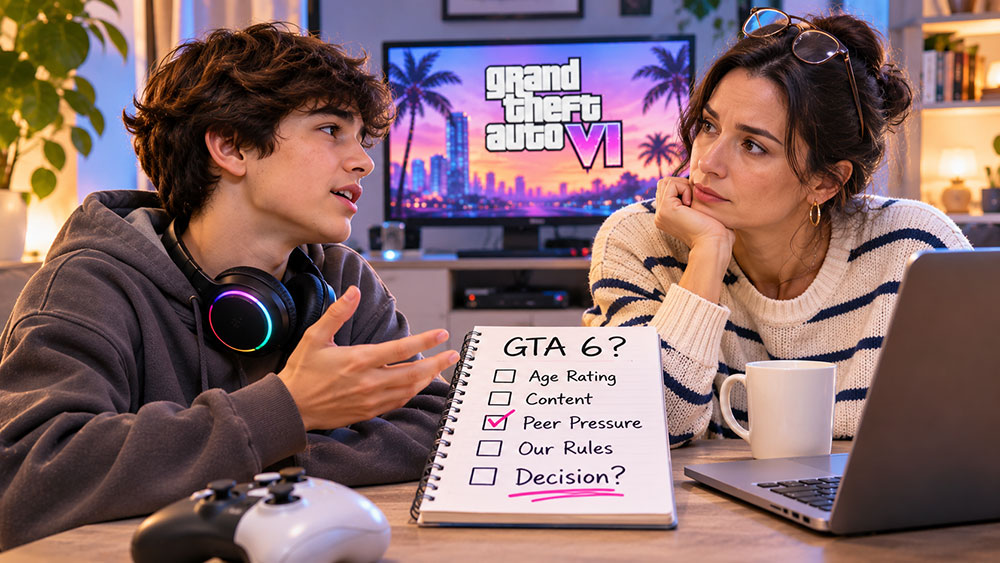
On one hand, you know that GTA 6 isn’t exactly a game designed for children. You’ve probably read about its violence, sexual content, drugs and strong language. On the other hand, you don’t want your teenager to feel left out of conversations happening at school, in group chats or among friends.
After all, gaming isn’t always just about playing a game. For teenagers, it can be a social activity. It’s something they discuss, share, watch and sometimes use as a way of connecting with friends.
So what happens when the most talked-about game among their classmates is one you’re not comfortable allowing at home?
Do you stand your ground? Do you make an exception? Or do you accept that your teenager might encounter GTA 6 anyway, even if you don’t buy it?
I think this is a much bigger conversation than simply whether parents should allow their children to play GTA 6.
When everyone at school seems to have GTA 6
GTA 6 has been one of the most anticipated video game releases in recent years. After more than a decade since the previous main instalment, the excitement surrounding its arrival has been enormous.
And when something becomes this popular, teenagers inevitably want to be part of the conversation.
They watch gameplay videos, discuss characters, share screenshots and compare their experiences. Some may be interested in the storyline, others in the open-world environment, and some simply want to play what their friends are playing.
For teenagers, being left out of these conversations can feel like a bigger deal than adults sometimes realise.
Imagine your child sitting with friends who are discussing a mission, a character or something funny that happened in the game. They have no idea what everyone is talking about because they’ve never played it.
It might sound like a small thing to us, but for a teenager trying to fit in, it can be frustrating.
And this is where peer pressure enters the picture.
Sometimes children don’t particularly want a game because they know much about it. They want it because everyone else seems to have it.
That’s an important distinction for parents to understand.
What are other parents doing? ABC News explores the GTA 6 dilemma
Interestingly, this isn’t just a conversation happening in our homes.
The article spoke to parents and child-development experts about the challenges of deciding whether teenagers should be allowed to play the game.
One mother, Rebecca Krane, explained that while her children were excited about GTA 6, she was uncomfortable with its adult themes. She also raised something many parents will recognise: even if she doesn’t allow the game at home, she cannot be certain her children won’t encounter it at school or a friend’s house.
That’s a rather realistic concern.
The ABC News feature also included a different perspective from Matthew Priest, a father of teenage boys who said he trusted his sons to distinguish between fictional game scenarios and real-life behaviour. He planned to allow them to play GTA 6 despite not necessarily approving of its themes.
These are two very different parenting approaches, and neither conversation is particularly unusual.
The article also included advice from parenting expert Catherine Hickem, who emphasised considering a child’s individual maturity and emotional readiness.
Psychologist Nicholas Kardaras, on the other hand, advised parents not to feel compelled to allow the game simply because it is popular among teenagers.
I think the most useful takeaway from the ABC report is that parents are dealing with two separate issues:
- Whether they’re comfortable allowing GTA 6 at home.
- Whether they can control what their teenagers encounter outside the home.
And those are not necessarily the same decision.
Common Sense Media has some useful advice for parents
Another resource worth reading is Common Sense Media’s detailed Grand Theft Auto VI Parent’s Guide and Game Review.
The review gives GTA 6 an age recommendation of 18+ and examines its violence, sexual content, nudity, language, drugs and alcohol.
What’s particularly useful is that it doesn’t treat all teenagers as identical.
Its review suggests that older, more mature teenagers may require an individual assessment, depending on their understanding of the content and the expectations established at home.
It also makes an interesting observation: children will probably hear about GTA 6 and see gameplay clips on YouTube and social media, whether or not the game is allowed in their homes.
Common Sense Media followed this up with another useful article on November 20, 2026: The GTA 6 Tips Every Gamer’s Parent Needs.
I particularly like a few of its suggestions:
- Ask your child why they want the game. Is it genuine interest or simply the group chat?
- If the answer is no, offer an alternative and explain when the decision might be revisited.
- If you decide to allow an older teenager to play, consider watching or playing the first hour together.
- Accept that your child might encounter the game at a friend’s house, and have conversations about what they see.
That last point is particularly important.
We sometimes approach parenting as though we can completely control everything our children watch, read, play or discuss.
But as they grow older, their world becomes considerably bigger than our homes.
Not buying GTA 6 doesn’t mean your child will never see it
This is perhaps the most important distinction parents need to make.
You can decide that GTA 6 isn’t appropriate for your teenager. You can refuse to buy it, restrict access to it on your home console and explain why you aren’t comfortable with its content.
But you cannot necessarily control what happens when your child visits a friend.
Perhaps someone brings a console to a gathering. Maybe a friend shows them a gameplay video on their phone. They might see clips circulating on social media or hear classmates discussing particular missions.
This doesn’t mean you should give up and allow everything.
It simply means that your parenting approach needs to account for the world outside your home.
There’s a difference between saying:
“I don’t want this game in our house.”
And saying:
“You must never watch, discuss or even encounter anything related to this game.”
The first is a household boundary. The second may be considerably harder to enforce with an older teenager.
And if your child does encounter GTA 6 elsewhere, wouldn’t you rather they felt comfortable talking to you about it?
I’d much prefer a teenager who can tell me what they’ve seen, ask questions and discuss something disturbing than one who feels they have to hide everything because they expect a lecture.
What if your teenager plays GTA 6 at a friend’s house?
This is a situation worth discussing before it actually happens.
You might have decided against buying the game, but your teenager’s friend has it. What happens when they’re invited over?
You could simply say that you don’t want them playing it anywhere.
You could also take a more conversational approach.
Explain why you aren’t comfortable with the game, discuss its content and tell your teenager what you expect if they encounter it elsewhere.
For example:
- They shouldn’t feel pressured to participate just because everyone else is playing.
- They can leave the room or choose another activity if the content makes them uncomfortable.
- They should understand that the fictional activities depicted in the game aren’t acceptable real-world behaviour.
- They should feel free to tell you if they’ve seen something disturbing or confusing.
You can also have a conversation with the friend’s parents if the children are spending a lot of time gaming together.
You don’t need to police another household, but it’s reasonable to discuss what your child is allowed to play when visiting.
And if you know that a particular household has very different rules, you can make decisions about how much unsupervised gaming time you’re comfortable with.
The problem with the “everyone else is allowed” argument
Let’s be honest. This is one of the most frustrating parts of parenting teenagers.
You say no, and they respond with a list of friends whose parents have said yes.
But here’s something to remember: you don’t actually know what every other family allows.
Some parents may have bought the game without checking its rating. Others may have looked at the content and decided that their older teenager is ready. Some might be allowing it because they don’t want an argument. And some may have decided against it altogether.
You only hear about the children who have the game.
You rarely hear about all the families who have quietly said no.
And even if every single one of your teenager’s friends had GTA 6, it wouldn’t automatically make it the right choice for your family.
You don’t have to be the most permissive parent in the group to be a good parent.
But I also wouldn’t dismiss your child’s feelings about being left out.
Instead of immediately shutting down the conversation, ask what they’re missing.
Is it the game itself? The opportunity to play with friends? The conversations? The feeling that they’re being treated differently?
You might discover that the actual problem is much smaller than it initially appears.
Six ways to handle the GTA 6 peer-pressure situation
If you’re currently dealing with repeated requests for the game, here are six approaches that might help.
1. Don’t make the decision during an argument
If your teenager asks for GTA 6 for the tenth time, you might be tempted to say no simply to end the discussion.
But try not to make an important decision when everyone is irritated.
Tell them you’ll look at the game, read its content rating and discuss it properly.
This also gives you time to understand what you’re being asked to approve.
2. Ask what their friends actually do with the game
Do they play together? Do they discuss the storyline? Do they share clips and screenshots?
Understanding the social element can help you decide whether there are other ways for your child to participate without actually playing.
3. Explain your decision without criticising their friends
Avoid saying things like, “Those children shouldn’t be playing it either.”
You don’t know the circumstances in every household.
Focus on your own decision.
You could say, “Different families make different decisions about games. I’ve looked at what’s in this one, and I’m not comfortable allowing it at the moment.”
4. Offer an alternative
If your teenager genuinely enjoys gaming, perhaps you can find another game that offers the exploration, driving, adventure or multiplayer experience they enjoy without the same level of mature content.
It doesn’t have to be an identical replacement.
The idea is to show that you’re not against gaming altogether.
5. Decide what happens outside the home
This is important.
Make your expectations clear about playing at friends’ houses, watching gameplay videos and accessing mature content online.
You may not be able to control every situation, but your teenager should understand your boundaries.
6. Be willing to revisit the conversation
A no today doesn’t have to be a permanent no.
Your teenager will grow older, develop better judgement and become more independent.
You can revisit the decision when circumstances change.
And if you eventually decide to allow the game, you can still establish reasonable expectations around gaming time, purchases and other responsibilities.
What if you have already said yes and now regret it?
Perhaps you bought GTA 6 without knowing exactly what it contained.
Or perhaps you initially allowed it because your teenager was upset about being left out, only to discover that the game was more graphic than you expected.
You can change your mind.
You don’t have to continue allowing something simply because you’ve already said yes.
But rather than suddenly removing the game without explanation, talk to your teenager.
Explain what you’ve discovered, what concerns you and why you think the arrangement needs to change.
They may not like it, but it’s better than pretending you are comfortable with something you aren’t.
And if you decide to continue allowing it, you can still introduce additional boundaries.
Parenting isn’t about making every decision perfectly the first time. Sometimes we learn more as we go along.
What should we do about gameplay videos and social media?
Here’s something else worth remembering.
Even if you don’t buy GTA 6, your teenager may encounter gameplay through YouTube, Instagram, TikTok or other social platforms.
Some videos show funny moments or driving sequences. Others contain graphic violence, sexual references and mature language.
You might be surprised by how much of the game your child can experience without actually owning it.
This is why I wouldn’t make the entire conversation about purchasing the game.
It’s worth discussing what they watch online too.
Talk about the difference between an edited gameplay clip and the full game. Encourage them to question what they’re seeing rather than automatically accepting everything presented as entertainment.
And remember that online videos can have their own age restrictions and content warnings, separate from the game’s rating.
A few warning signs parents should watch for
Peer pressure isn’t necessarily harmful by itself. Wanting to participate in something your friends enjoy is a normal part of growing up.
However, it’s worth paying attention if gaming begins affecting other areas of your teenager’s life.
For example:
- Their sleep schedule is becoming increasingly disrupted.
- Schoolwork and other responsibilities are being neglected.
- They are withdrawing from hobbies or activities they previously enjoyed.
- They become unusually irritable when asked to stop playing.
- They seem unable to enjoy time with friends without gaming being involved.
These aren’t proof that GTA 6 is responsible. They are reasons to look at the bigger picture of your child’s gaming habits.
If the changes are significant or persistent, consider seeking professional advice.
So, how do we handle the pressure?
I think the GTA 6 situation is a useful reminder that parenting teenagers involves a lot more than simply setting rules.
When children are younger, we make most of their entertainment choices. As they grow older, their friends, interests and social circles become increasingly important.
We cannot make every decision for them forever.
But we can help them understand why certain boundaries exist, how to deal with peer pressure and how to make sensible decisions when we’re not around.
You might decide that GTA 6 isn’t appropriate for your teenager. Another parent might make a different decision for their older child.
Both families can have their reasons.
The important thing is that popularity shouldn’t be the only factor influencing your decision.
And perhaps we should stop thinking that allowing a game at home is the only way to ensure our children aren’t left out of conversations about it.
You can say no to the game while still saying yes to a conversation.
You can maintain your household rules while acknowledging that your teenager lives in a world where they will encounter things you don’t necessarily approve of.
And you can disagree with their choices without making them feel that they cannot talk to you.
Sometimes, that’s the more important parenting skill.
Let’s hear from other parents!
I’m particularly interested in how families are handling the GTA 6 excitement now that the game is out.
If you have a teenager at home, I’d love to know:
- Has your child asked you to buy GTA 6?
- What age is your teenager?
- Do their friends own the game or are they planning to buy it?
- Have you said yes, no or are you still deciding?
- If you’ve said no, are you comfortable with your child playing it at a friend’s house?
- Have you had arguments about gaming because your teenager feels left out?
I’m especially interested in hearing from parents who have taken different approaches.
Let’s share experiences rather than judge one another. After all, most of us are trying to figure out the same thing: how to give our teenagers some independence without abandoning our responsibilities as parents.
Leave a Reply