Imagine a classroom without walls.
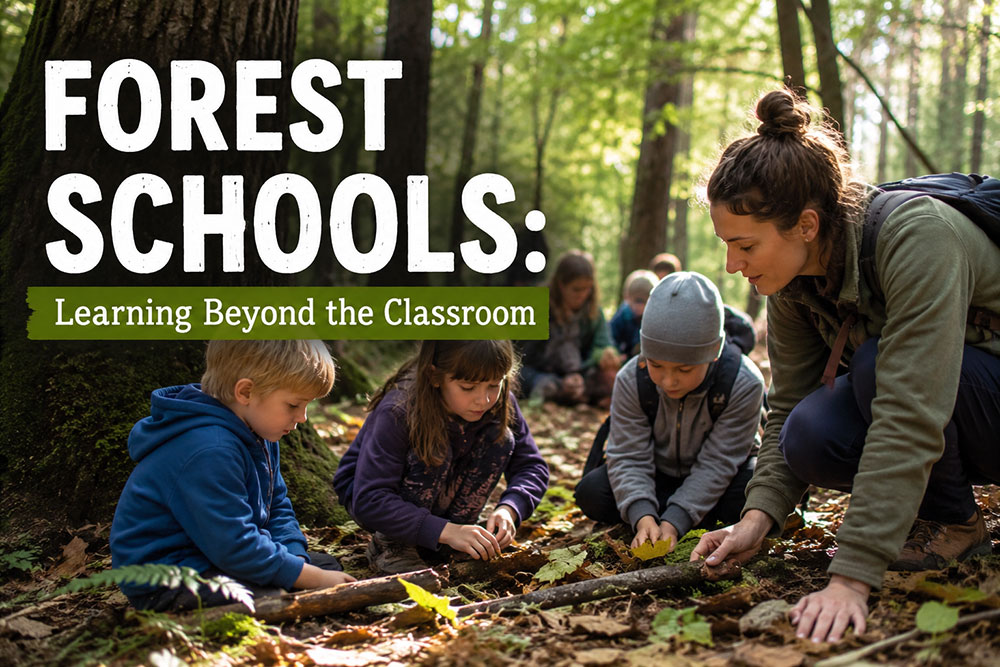
Instead of desks and whiteboards, there are trees, streams, birds, mud, logs, insects and changing seasons. Lessons aren’t confined to textbooks. Children learn by climbing, building shelters, observing wildlife, identifying plants, solving problems together and experiencing nature firsthand.
This is the idea behind Forest Schools, an educational approach that has gained popularity in many parts of Europe, North America, Australia and increasingly, Asia.
While the name suggests children spend all their time in forests, that’s not quite true. Forest School is less about the location and more about a philosophy of learning—one that believes children develop confidence, resilience and curiosity through regular, meaningful experiences in nature.
What Is a Forest School?
Forest School is a child-centred approach to education that takes learning outdoors on a regular basis.
Rather than occasional nature walks or annual camping trips, children spend scheduled time in natural environments throughout the year, regardless of the season. Sessions may take place in forests, parks, woodlands, gardens, beaches or other natural spaces.
The emphasis is on exploration rather than instruction. Teachers act as facilitators, allowing children to ask questions, experiment, make mistakes and discover solutions.
Many Forest Schools follow six core principles, including regular outdoor sessions, learner-led activities, supported risk-taking and holistic development.
Where Did Forest Schools Begin?
The modern Forest School movement traces its roots to Scandinavia, particularly Denmark and Sweden, where outdoor play has long been considered an essential part of childhood.
The concept spread to the United Kingdom in the 1990s after British educators studied Scandinavian practices. Today, Forest Schools can be found in countries including Canada, the United States, Germany, New Zealand, Japan and India.
Some are full-time schools, while many traditional schools incorporate Forest School sessions once or twice a week.
What Do Children Actually Do?
Every Forest School looks a little different, but activities often include:
- Building dens and shelters
- Climbing trees safely
- Nature walks
- Bird watching
- Identifying plants and insects
- Gardening
- Storytelling outdoors
- Nature-inspired art and crafts
- Cooking over a supervised campfire
- Measuring, counting and estimating using natural materials
- Team challenges
- Journaling and sketching
- Weather observations
- Wildlife conservation projects
The goal isn’t simply outdoor recreation. Each activity develops academic, physical, emotional and social skills.
How Does Learning Happen?
Forest Schools don’t separate learning into rigid subjects.
A single morning outdoors can naturally combine multiple disciplines.
For example, while building a shelter, children may learn:
- Mathematics by measuring branches and estimating angles
- Science by understanding different materials and weather conditions
- Language through discussions and storytelling
- Engineering by solving structural problems
- Teamwork through collaboration
- Leadership by organizing tasks
Learning becomes interconnected rather than compartmentalized.
Benefits of Forest Schools
Builds Confidence
Children are encouraged to try new things, solve problems independently and make decisions.
Successfully climbing a hill, building a shelter or lighting a campfire under supervision can create a strong sense of achievement.
Encourages Curiosity
Nature constantly changes.
Children observe seasonal changes, discover insects, identify leaves, follow animal tracks and ask questions that don’t always have immediate answers.
This nurtures genuine curiosity rather than memorization.
Improves Physical Health
Outdoor learning naturally encourages movement.
Children climb, balance, run, dig, carry, jump and explore in ways that improve strength, coordination and overall fitness.
Develops Emotional Resilience
Unlike highly controlled indoor environments, nature presents real but manageable challenges.
Rain, uneven ground, changing weather and unexpected situations help children become more adaptable and resilient.
Supports Mental Well-being
Research has consistently found that spending time in natural environments can reduce stress and improve mood, attention and emotional well-being.
Many educators report that children often appear calmer and more focused after outdoor learning sessions.
Enhances Social Skills
Many activities require cooperation rather than competition.
Children work together to solve problems, share resources and communicate effectively.
Encourages Environmental Responsibility
Children who regularly spend time in nature often develop a stronger appreciation for wildlife and conservation.
Protecting the environment becomes a personal value rather than an abstract lesson.
The Challenges of Forest Schools
Like every educational approach, Forest Schools also have limitations.
Weather Can Be Unpredictable
Outdoor learning continues in rain, cold and heat, provided conditions are safe.
Families need appropriate clothing, footwear and a willingness to embrace changing weather.
Limited Availability
Full-time Forest Schools remain relatively uncommon in many countries.
Parents may need to travel farther or choose schools that incorporate only partial outdoor programmes.
Academic Balance
Some parents worry whether enough time is devoted to traditional academics.
Most Forest Schools balance outdoor learning with classroom instruction, but the ratio varies from school to school.
Safety Concerns
Forest Schools encourage calculated risk rather than eliminating risk entirely.
Children may use simple tools, climb trees or build fires under close supervision.
While these experiences teach responsibility, they may initially make some parents uncomfortable.
Not Every Child Enjoys Outdoor Learning
Some children love mud, insects and adventure.
Others prefer structured classrooms, quiet reading or indoor creative activities.
Neither preference is wrong.
Common Misconceptions
“Children just play all day.”
Play is an important part of Forest Schools, but it is purposeful.
Children develop problem-solving, communication, observation and critical-thinking skills through carefully designed activities.
“There is no academic learning.”
Academic concepts are integrated into real-life experiences rather than taught only through textbooks.
“Forest Schools are only for preschoolers.”
While many early childhood programmes adopt this approach, Forest School principles can benefit learners of all ages.
Are Forest Schools Available in India?
Forest Schools are still relatively new in India, but interest is growing. So Yes, there are forest schools in India!
Some international schools, alternative schools and early childhood centres now include nature-based learning, outdoor classrooms and regular forest or farm visits.
A few schools have adopted Forest School principles as part of their curriculum, while independent organizations also conduct Forest School programmes, nature camps and wilderness learning experiences.
Parents interested in this approach should carefully evaluate how much outdoor learning is genuinely integrated into the programme rather than assuming the name alone reflects the educational philosophy.
Is a Forest School Right for Your Child?
Forest Schools may be a good fit if your child:
- Loves spending time outdoors
- Learns through hands-on experiences
- Enjoys exploring independently
- Is naturally curious
- Benefits from movement rather than sitting for long periods
- Enjoys science, wildlife and nature
It may be less suitable for children who strongly prefer structured classroom environments or who require specialised indoor learning support, though many schools successfully adapt activities for diverse learners.
Can Families Bring Forest School Ideas Home?
You don’t need to enrol in a Forest School to enjoy many of its benefits.
Simple activities include:
- Regular walks in local parks
- Gardening together
- Nature scavenger hunts
- Bird watching
- Collecting leaves, stones and seeds for art projects
- Outdoor storytelling
- Growing vegetables or herbs
- Stargazing
- Nature journaling
- Building simple shelters using fallen branches
The key is giving children time to observe, explore and ask questions rather than constantly directing every activity.
The Bottom Line
Forest Schools challenge the idea that meaningful learning only happens inside classrooms.
By combining exploration, play, responsibility and real-world experiences, they help children develop confidence, resilience, creativity and a lasting connection with the natural world.
They are not intended to replace every traditional educational model, nor are they suitable for every family. But as childhood becomes increasingly dominated by screens and structured schedules, the Forest School philosophy offers a valuable reminder that some of life’s most important lessons can still be learned beneath the open sky.
Leave a Reply