Colmar sits on the main line through Alsace, so plenty of visitors arrive with a few hours between one train and the next. Those few hours are enough for the good bits, as long as you’re not hauling a wheeled case over cobbles. Deal with the bag first and then forget about it for the rest of the day.
Sorting the bag before anything else
Colmar’s station is a short walk from the old town, maybe ten or fifteen minutes at an easy pace. It’s a pleasant walk with nothing in your hands and a fairly miserable one with a wheeled case on cobbles. So the first job is finding somewhere to leave it.
Booked storage in Colmar runs through shops and hotels around town, not through one big facility, and some of the spots near the station take bags from early in the morning. Check luggage storage in Colmar before setting off rather than hoping to find something on the day, since the options are small businesses and they do fill up.
The museums won’t help. The Unterlinden currently has nowhere to leave bags, so don’t count on it. The Musée Bartholdi does have a reception cloakroom where bulky luggage has to be deposited. Backpacks have to be carried by hand or worn on your front once you’re inside.
Travelling light changes the calculation. A small daypack you can wear on your front is fine, and you can probably skip all of this.
Anything bigger, book something.
What to do with the half day
Alsace has passed between France and Germany more than once, and Colmar looks and eats like a town that’s changed hands. The timber houses would sit happily on the other side of the Rhine, and so would a good deal of what turns up on the menus. Most of what you’ll be looking at over the next few hours comes out of that.
Once you’re unencumbered, walk into the old town and don’t overthink the route. Colmar is compact, and the half-timbered streets are the attraction in themselves. The buildings lean and the colours are ridiculous. There’s no route worth planning, because the lanes are short and a wrong turn costs you about two minutes. Most of the pleasure is in the wandering, so give yourself a good hour for it.
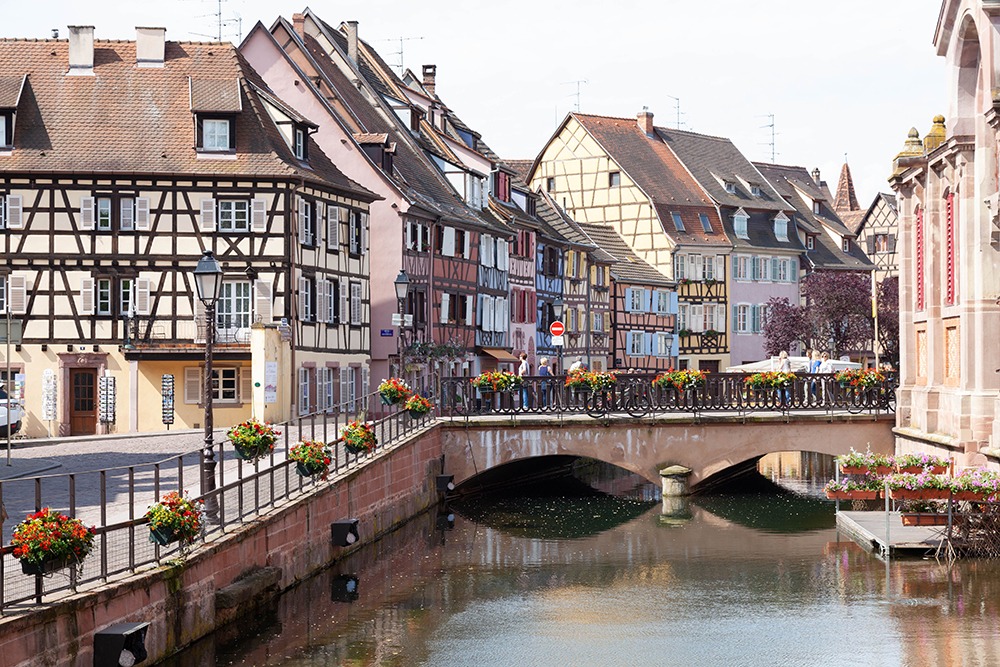
La Petite Venise is the postcard quarter, and it does deserve the fuss. It’s the canal district, with flower boxes on the bridges and houses coming right down to the water. It is small, so you won’t need long. Walk up one side and come back along the other, stopping on a bridge for the photograph everyone takes. Mid-morning or late afternoon tends to be calmer than the middle of the day. On a summer weekend it’s busy whenever you turn up.
The Marché Couvert, the covered market down by La Petite Venise, is worth twenty minutes if it’s open when you pass. There are cheese and charcuterie stalls, and produce from the wine country that starts more or less at the edge of town. It’s also a sensible place to put together something to eat on the train, which saves you sitting down for a full lunch you don’t have time for.
With three hours or more, the Unterlinden Museum is the one to do. The Isenheim Altarpiece is genuinely one of the great things in Europe, and people travel a long way specifically to stand in front of it. Allow an hour and a half at minimum, and probably more if you’re the sort who reads everything. With less time than that, skip it. A hurried look at the altarpiece is a bit of a waste, and the old town on its own is a perfectly good half day.
The Musée Bartholdi is the smaller alternative, in the house where the sculptor who made the Statue of Liberty was born. It fits more comfortably into a tight stopover, and you can be in and out inside an hour. Just remember the cloakroom rules if you’re carrying anything.
Wine is the other obvious temptation, given where you are. A glass of Riesling or Pinot Gris somewhere in the old town is a nice way to spend twenty minutes, and a tarte flambée is the thing to order with it. Keep it to one if you’ve got a connection and a bag to collect.
Getting back for your train
Give yourself more time than you think you need. The storage spot might sit a few streets off your direct line to the platform, and the walk back is the same ten or fifteen minutes it was on the way in. It feels a lot longer when you’re watching the clock. Collect the bag first and then head for the station. Going to the station first and doubling back for the bag is how people cut it fine.
Thirty minutes between leaving the old town and your departure is comfortable, and twenty is doable. Below that, you’ll spend the last part of a nice half day power-walking past buildings you meant to look at. Check the platform when you arrive, then sit down with whatever you managed to pick up.
Leave a Reply