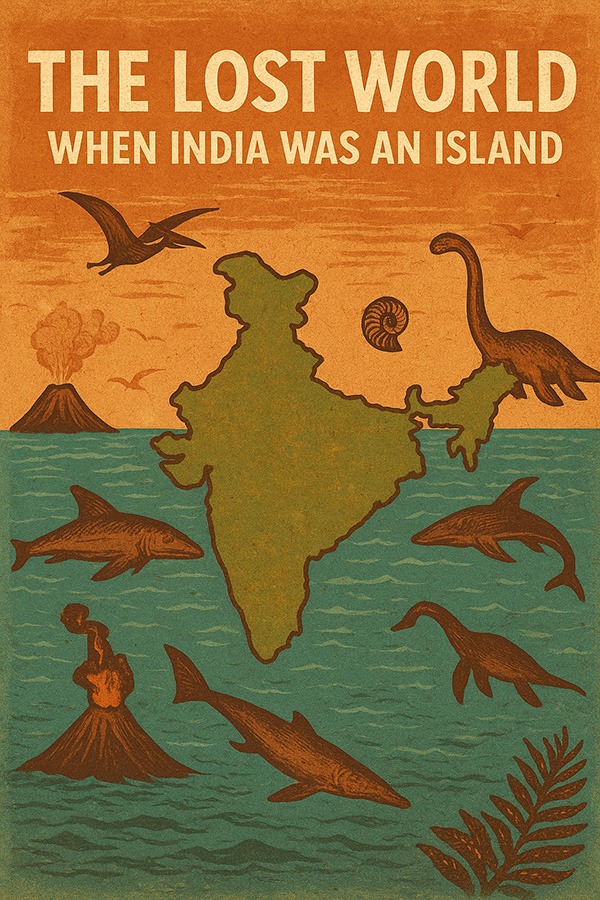
Imagine India — not as part of Asia — but as a vast island drifting alone across the ocean. Millions of years ago, that’s exactly what it was. Long before the Himalayas existed, before humans or even modern mammals, India was an isolated landmass on a slow but powerful journey that would eventually reshape the face of the Earth.
This is the story of India’s epic voyage — a geological adventure that turned a tropical island into a subcontinent and gave birth to the tallest mountains in the world.
When India Broke Away
About 120 million years ago, during the Cretaceous Period, India was part of a giant southern supercontinent known as Gondwana, along with Africa, Australia, South America, and Antarctica.
Then, powerful forces beneath Earth’s crust caused Gondwana to split apart.
-
The Indian Plate broke away from Madagascar around 88 million years ago.
-
For the next 30 million years, it sailed northward through the Tethys Ocean — a prehistoric sea that once separated Africa and Asia.
-
Scientists estimate India was moving at an incredible speed of 15–20 cm per year — one of the fastest tectonic movements ever recorded in Earth’s history.
At that time, India was a lonely tropical island, filled with volcanoes, lush forests, and dinosaurs roaming freely.
The Island of Giants
Fossil discoveries from central India, especially in places like the Narmada Valley, reveal a rich prehistoric ecosystem.
Among the fascinating finds:
-
Rajasaurus narmadensis, a ferocious carnivorous dinosaur unique to India, roamed these lands.
-
Early mammals, crocodiles, and turtles thrived in the warm, humid environment.
-
Gigantic Deccan volcanoes periodically erupted, shaping the landscape and releasing vast amounts of lava — known today as the Deccan Traps.
These eruptions would later play a major role in one of Earth’s greatest extinction events.
The Great Collision
Around 50 million years ago, India’s northward drift brought it face-to-face with Asia.
When the two continental plates collided, neither could sink because both were too light. Instead, they crumpled and rose upward, giving birth to the Himalayas and the Tibetan Plateau.
This monumental event:
-
Closed the ancient Tethys Sea.
-
Changed global climate and wind patterns.
-
Created some of the youngest, highest mountains on the planet — which are still rising today!
Even now, India continues to move about 5 cm north each year, pushing the Himalayas higher.
Life After the Collision
The impact didn’t just shape geography — it changed the course of evolution.
-
India’s wildlife, once isolated, now mingled with species from Asia.
-
Tropical ecosystems evolved into a variety of biomes: from the Thar Desert to Himalayan forests.
-
The land became fertile, supporting life and eventually, human civilization.
The Indian subcontinent transformed from an island of dinosaurs into a cradle of biodiversity and culture.
Scientific Clues: How We Know This
Geologists and paleontologists have pieced this story together using:
-
Fossil records: Unique dinosaur fossils and plant remains found only in India.
-
Magnetic evidence: Ancient rocks retain traces of Earth’s magnetic field, showing how India’s position shifted over time.
-
Seafloor studies: Patterns on the ocean floor confirm the direction and speed of India’s drift.
Each clue helps us reconstruct how India’s island journey shaped our modern world.
Legacy of the Island That Became a Continent
India’s story is more than ancient geology — it’s a symbol of transformation and resilience.
From volcanic wilderness to the towering Himalayas, India’s journey reminds us that even the slowest changes can reshape our planet in unimaginable ways.
Next time you see the mountains, remember — they were born when an island collided with a continent, changing Earth forever.
Conclusion
Millions of years ago, India wasn’t where it is today. It was an island on a grand voyage across the ocean — carrying dinosaurs, forests, and secrets of a world long lost. Its collision with Asia not only created the Himalayas but also set the stage for the landscapes, climates, and ecosystems we know today.
The story of India as an island is a powerful reminder: our planet is alive, moving, and evolving — and we’re just a moment in its long, incredible journey.
Leave a Reply