The Super Bowl LX is not merely a football game; it is the logistical puzzle that will be distributed in three major cities in the San Francisco Bay Area. Unlike the recent Super Bowls in Las Vegas or New Orleans, where the activity was concentrated in one location, the 2026 event will make the families find their way in the Tri-City Ecosystem: the Game Zone in Santa Clara, the Fan Zone in San Francisco, and the Opening Night in San Jose.
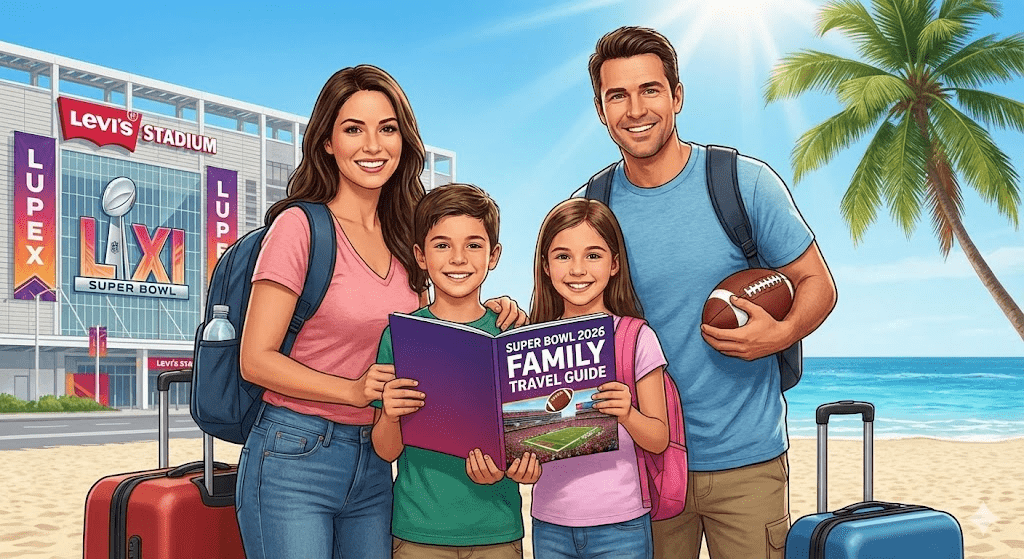
Image Credit – Gemini
This decentralized form of structure poses a special challenge to families. You may have analysts and fans arguing and debating the Super Bowl Odds on the field, but your chances of success and a stress-free trip depend solely on how your family will approach the field. Whether it is strict infant ticketing policies or traversing the so-called Atmospheric River season, this guide will provide all the information you should know to survive and thrive through the Super Bowl week.
1. The Event Matrix: What You Are Walking Into
Before booking flights, you must understand the physical environment of Super Bowl LX.
- The Venue: Levi Stadium is an open-air stadium. You are exposed to the elements as compared to the domes of recent years. The Bay Area in February may either be sunny and gorgeous or may have high-pressure rainfall in the form of the so-called Atmospheric River.
- The Temperature Swing: Games are scheduled to start at 3.30 PM PST with varying sunlight, but come the fourth quarter sun will be down, and temperatures will plummet into 5the 0s or 40s.
- The Entertainment: The halftime show includes Bad Bunny, and consequently, it is going to be a very energetic performance that is accompanied by a great amount of pyrotechnics. When you have children who are sensitive to sound, it is an indication that you need to carry along noise-cancellation headphones.
Strategic Insight: Don’t bet against the weather. No matter the odds, the prediction is the one stat you have to follow daily.
2. The “All-Persons” Ticket Policy (Read This First)
The barrier that the family will face the most when attending Super Bowl LX is the NFL policy of strictness regarding children in terms of tickets.
The Rule: All human beings who come to the stadium, irrespective of their age or size, should have a valid and full-priced ticket.
- No Lap Passes: In contrast to normal season games, in which the babes in arms may be free, the Super Bowl does not allow it.
- The Cost: Resale tickets are frequently around $4,000 and above, which implies that a family that has a six-month-old child will spend extra money to buy an extra full-price ticket.
- The Logic: Although it is expensive, the additional seat is operationally warranted. You will have the room to carry around the supplies that you are allowed (see below).
Warning: This is strongly enforced by gate agents. You cannot gain admission to a ticketless baby by talking your way in; you simply cannot.
3. Security: The “Clear Bag” and Diaper Bag Ban
The security at the Super Bowl, as a National Security Special Event (NSSE), is much stricter than an ordinary NFL Sunday.
The Diaper Bag Prohibition
The traditional diaper bag is not allowed (they are usually a multi-pocket, non-transparent bag). You cannot bring them in.
The Family “Kit” Strategy
To survive 6+ hours in the stadium with kids, you must adapt to the “Clear Bag Policy”:
- The Vessel: Buy an NFL-approved transparent tote bag (no larger than 12 x 6 x 12) for all ticketed family members.
- The System: Sort the supplies in the tote using clear Ziploc freezer bags. Prepare one Ziploc with diapers/wipes, one with snacks, and one with layers. This is to enable security to screen your bag without emptying it.
- Medical Exceptions: Although breast pumps and medically necessary goods are admitted through certain gates called Medical Bags, they are screened in dedicated gates, which are time-consuming. In case you can, pack non-medical childcare stuff in the normal transparent totes to make your entrance quicker.
Stroller Logistics: There are no restrictions on strollers in the stadium plaza, but in the seating bowl, it is forbidden. They have to be checked at Guest Services (Gate C or F). Pro Tip: A cheap umbrella stroller that you do not mind selling is much better than a $1,000 travel system. The next thing to do is to use a baby carrier (Ergobaby/Bjorn) to traverse the busy concourses.
4. Geographic Strategy: Where to Stay
Because the events are 45 miles apart, you must choose a “Home Base.”
Zone A: The “Game Day” Hub (Santa Clara)
- Best For: Families with young children (under 10) who want to minimize travel stress on Sunday.
- Top Picks: Hyatt Regency Santa Clara: Adjacent to the stadium; walk to the gates.
- Embassy Suites Santa Clara: Indoor pool (rain hedge) and free breakfast.
- The Trade-off: You are far from the parties in San Francisco. To visit the Super Bowl Experience, you face a 1-hour commute north.
Zone B: The “Fan Experience” Hub (San Francisco)
- Best For: Families with teenagers, first-time tourists, and those attending the NFL Honors or concerts.
- Top Picks: InterContinental SF: Walking distance to Moscone Center (Fan Zone).
- Handlery Union Square: One of the few SF hotels with a heated outdoor pool.
- The Trade-off: The Sunday commute to the game is brutal. You must take Caltrain to Mountain View and transfer to the VTA light rail, a journey that can take 3 hours round-trip.
Zone C: The “Airport” Strategy (San Jose – SJC)
- Best For: Budget-conscious families and efficient travelers.
- Top Picks: Hotels near SJC airport offer lower rates and are only 6 miles from the stadium via VTA bus/rail.
5. Transportation: The Mobility Plan
Traffic in the Bay Area is notoriously difficult. On Super Bowl Sunday, it will be gridlock.
- Fly into SJC (San Jose): If your priority is the game, fly here. It is minutes from the stadium. SFO is a distant second choice. Avoid Oakland (OAK) due to bridge traffic.
- VTA Light Rail: This is the “Last Mile” solution. The Great America Station is right in front of the stadium. Download the Clipper app for fares; do not buy paper tickets at the machine on game day.
- Avoid Rideshare: Uber/Lyft drop-off zones (Red Lot 7) are a 15-20 minute walk from the gates. With tired toddlers, this walk is a marathon.
- Parking: If you drive, pre-pay for a pass ($100-$500). Follow the route map on the pass, not Google Maps, as road closures will be extensive.
6. The Week-Long Itinerary
Pacing is key. Don’t burn the kids out before kickoff.
- Monday (Feb 2): Opening Night (San Jose). The only time to see players up close. Cheap tickets (~$30) are great for autograph hunting.
- Tuesday – Saturday: Super Bowl Experience (San Francisco). Held at the Moscone Center. Kids 12 and under are FREE. This is the highest ROI event for families. Register for the NFL OnePass app before you go to skip the waivers line.
- Must Do: Run the 40-yard dash against LED avatars of players and get a photo with the Vince Lombardi Trophy.
- Tuesday: Pro Bowl Games (SF). A skills competition that is much more relaxed and kid-friendly than the Super Bowl itself.
Note: Major concerts (Sting, Chris Stapleton) are late-night events. If you are tracking the Super Bowl Odds of a meltdown, keeping kids out past 11 PM for a concert is a sure bet for a tantrum the next day.
7. Non-Football Diversions
When the kids need a break from football, the Bay Area offers world-class distractions.
- The Tech Interactive (San Jose): Build robots and explore IMAX. Perfect for ages 7-14.
- California’s Great America: Located next to the stadium, but WARNING: it is typically closed in February. Do not promise rollercoasters.
- Exploratorium (SF): The gold standard of science museums. Located at Pier 15, it’s a full-day engaging activity for toddlers to teens.
8. Game Day Operations: The Tactical Guide
Sunday, February 8, 2026
- 09:00 AM: Breakfast and Hydration. You can bring factory-sealed water bottles (up to 24oz) into the stadium. Pack them.
- 11:30 AM: Arrive at the security perimeter.
- Tag-A-Kid: Immediately locate a Guest Services tent. Register your child to receive a wristband with your seat location and phone number. In a crowd of 70,000, this is your safety net.
- The Exit Strategy: When the game ends (~7:30 PM), do not rush the exits. The crush for VTA trains will be overwhelming. Sit in your seats for 45 minutes. Let the initial wave clear, use the restrooms, and let the kids decompress.
Summary Checklist
- Tickets: Confirm every infant has a paid ticket.
- Apps: Download NFL OnePass and Clipper (Transit).
- Gear: Clear bags packed with layers (beanie/gloves) and noise-canceling headphones.
- Patience: The Super Bowl is a marathon.
By following this guide, you can navigate the logistical hurdles of the Bay Area and focus on the memories. Whether your team beats the Super Bowl Odds or not, your family trip will be a victory.




Leave a Reply